The MLOps Foundation CTOs Need for Reliable AI Products
- Tensorplay Engineering
- 27 Aug, 2026
- 02 Mins read
- Production-ai,Infrastructure
The operating model behind reliable AI
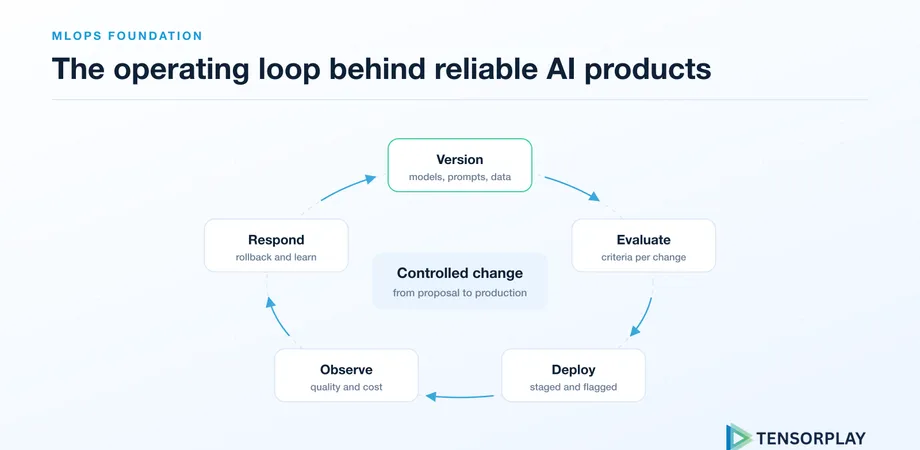
MLOps is the set of operating capabilities that lets a team change and run an AI product without losing control of quality, risk, or cost. For LLM applications, it applies to prompts, retrieval data, model configurations, tool definitions, and conventional application code.
The goal is not a large platform for its own sake. It is a reliable path from a proposed change to a measured production outcome. Our AI engineering services focus on building that path around the product your team already owns.
1. Version the things that affect behavior
Record the model identifier, prompt, retrieval configuration, data source version, tool definition, and application release that produced a result. Without this record, teams cannot investigate regressions or reproduce an incident.
When using Hugging Face, model and dataset versions should be part of this record. For API-based systems, capture the deployed configuration and the relevant provider model identifier through a controlled release process.
2. Connect change to evaluation
Every meaningful model, prompt, retrieval, or tool change should run the relevant test cases before release. This does not need to be a single universal score. It needs to reflect the quality and safety criteria for the workflow being changed.
Use the CTO LLM evaluation framework to define those criteria, then preserve the results with the release. This makes tradeoffs auditable and gives product and engineering a common launch language.
3. Deploy gradually and observe the result
Use feature flags, staged exposure, rollback criteria, and operational dashboards. Monitor technical signals such as latency and error rates alongside product-specific quality signals. An apparent model regression may originate in a retrieval pipeline, a source-data update, or a dependency failure.
Teams on AWS can combine managed services and custom GPU workloads, but the architecture should fit the operating model. See the AWS AI infrastructure integration for the areas Tensorplay supports.
4. Give incidents and ownership a home
Name an owner for model behavior, data ingestion, infrastructure, security, and the release decision. Define how a customer-reported failure is triaged, reproduced, fixed, and added to future evaluation coverage.
This is the operational layer behind the AI PoC to production timeline. For a practical MLOps assessment or implementation roadmap, contact Tensorplay.
Frequently asked questions
Answers to common questions about this topic.
What is the minimum MLOps foundation for an AI product?
Does an LLM application need MLOps?
How is MLOps different from DevOps?
Related articles
LLM Inference Cost Optimization: A CTO Playbook
Where inference spend really comes from The most durable way to reduce LLM inference cost is to unde...
How to Make a RAG System Reliable in Production
The reliability boundary in RAG A reliable RAG system retrieves authorized, current, relevant eviden...
AI Production Readiness Checklist for CTOs
What production-ready actually means An AI feature is ready for production when your team can measur...
How Tensorplay can help
Production AI Architecture
Turn prototypes into reliable, observable, and scalable AI systems.
Discuss your projectAI Infrastructure & Security
Build secure inference platforms with predictable performance and spend.
Discuss your project