AI Production Readiness Checklist for CTOs
- Tensorplay Engineering
- 06 Aug, 2026
- 02 Mins read
- Production-ai,Engineering
What production-ready actually means
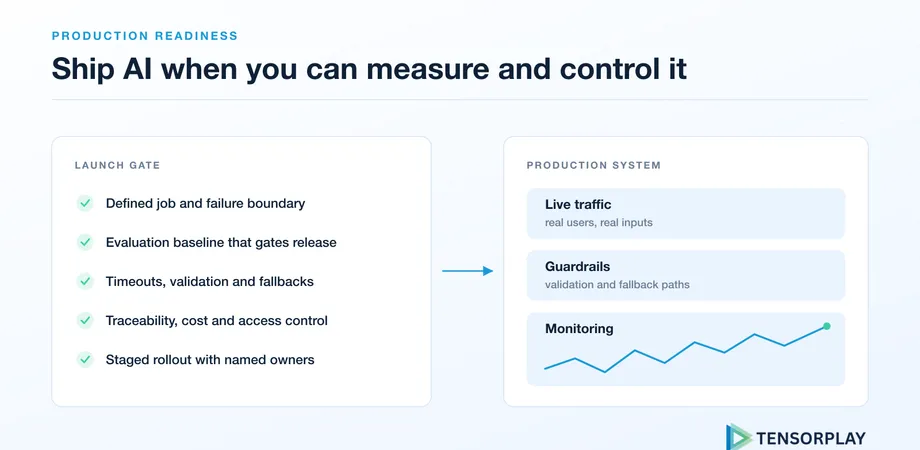
An AI feature is ready for production when your team can measure whether it is working, control how it fails, and operate it within an agreed cost and risk boundary. A successful demo only proves that a model can produce a useful result for a narrow path.
For a realistic delivery plan, start with the AI engineering services Tensorplay provides and use this checklist to identify the work that remains.
1. Define the job and the failure boundary
Write down the user decision or workflow the system supports, the inputs it may handle, and the outcomes that are unacceptable. For an assistant, that may include unsafe advice, an unsupported claim, a leaked document, or a response that arrives too late to be useful.
This definition gives the team something concrete to evaluate. It also prevents a launch review from becoming a debate about whether outputs merely look impressive.
2. Establish an evaluation baseline
Create a representative set of inputs, expected behavior, and pass criteria. Include normal requests, edge cases, adversarial inputs, and known historical failures. Run it when prompts, models, retrieval logic, or tools change.
The LLM evaluation guide explains how to turn this baseline into an operating discipline. Teams using OpenAI or Hugging Face should evaluate the exact model and configuration they plan to deploy, not a notebook substitute.
3. Design for bad days
Model providers throttle requests, documents arrive malformed, and downstream tools time out. Decide what the user sees when each dependency fails. Add timeouts, retries where safe, validation at model and tool boundaries, and an explicit fallback or escalation path.
For agent workflows, this is especially important: see our guide to building multi-agent AI systems in production. A workflow should stop cleanly when it cannot establish a trustworthy next step.
4. Prove the operational basics
Before launch, confirm that the team can answer these questions from logs and dashboards:
- Which model, prompt version, retrieval source, and tool calls produced this result?
- What are the latency, error, and quality signals for each key flow?
- Which customer or tenant incurred the cost?
- Who can access the data, and how are changes reviewed and rolled back?
If you are deploying on AWS, the AWS AI infrastructure integration outlines the cloud building blocks we support. For retrieval applications, validate data freshness, permissions, and recall as carefully as model output.
5. Plan the rollout, not just the release
Start with a constrained audience, record the acceptance criteria, and decide who responds to regressions. A staged rollout makes it possible to learn without exposing the entire customer base to an unproven workflow.
For a phase-by-phase view, read from AI PoC to production. If you want an independent readiness assessment before launch, talk to Tensorplay about your AI system.
Frequently asked questions
Answers to common questions about this topic.
What makes an AI system production-ready?
When should a team assess AI production readiness?
Who should own AI production readiness?
Related articles
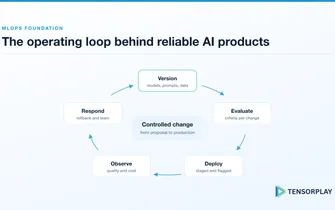
The MLOps Foundation CTOs Need for Reliable AI Products
The operating model behind reliable AI MLOps is the set of operating capabilities that lets a team c...
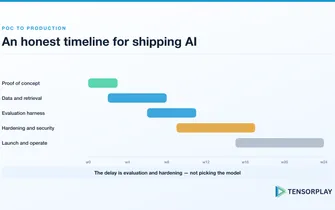
From PoC to Production: An Honest Engineering Timeline
One of the most frequent conversations we have with new clients starts the same way: "We have a work...
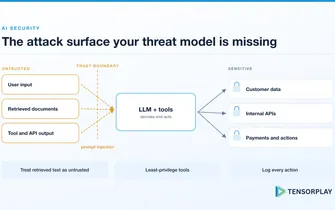
Securing AI Applications: The Threat Model You Haven't Thought About
Enterprise teams investing in AI security are mostly focused on the wrong things. Compliance checkli...
How Tensorplay can help
Production AI Architecture
Turn prototypes into reliable, observable, and scalable AI systems.
Discuss your project