How CTOs Should Build an LLM Evaluation Framework
- Tensorplay Engineering
- 11 Aug, 2026
- 02 Mins read
- Evaluation,Llm
The evaluation decision CTOs need to make
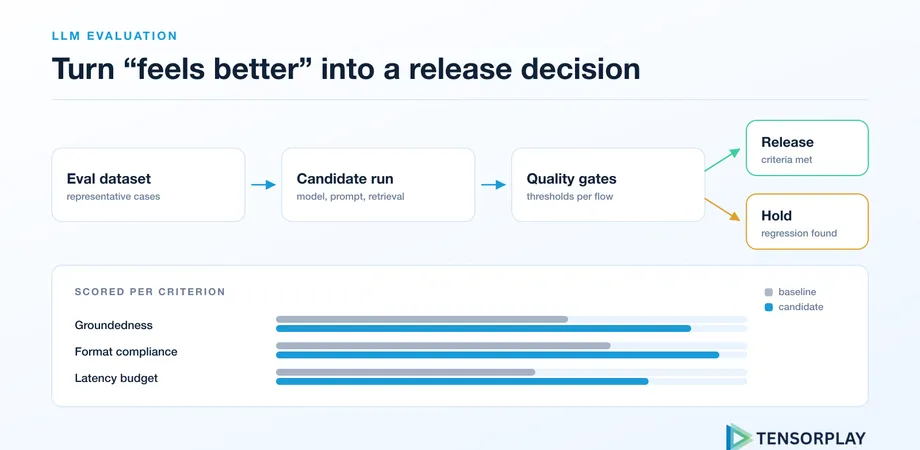
An LLM evaluation framework converts “does this feel better?” into a repeatable release decision. It combines a representative dataset, explicit quality criteria, automated checks, and a process for reviewing the cases automation cannot judge reliably.
This is part of the production-readiness work described in our AI production readiness checklist. Without it, model upgrades and prompt edits become unmeasured product changes.
Start from a user decision
Do not begin with a generic benchmark. Pick the decisions your system helps users make, then identify what a good and bad result looks like in that context. A support assistant may need grounded answers with correct citations; an extraction workflow may need a strict schema and high field accuracy.
For each flow, define:
- a curated input set that represents real use;
- expected properties or reference answers;
- a threshold and an owner for exceptions;
- latency and cost limits alongside quality measures.
Test every system boundary
An LLM result depends on more than the model. Evaluate retrieval quality, tool selection, structured output parsing, and fallback behavior. For systems built with LangChain and LangGraph, include state transitions and tool failures in the test set, not only final text.
If you use OpenAI or an open-source model from Hugging Face, capture the exact model version and inference configuration in every run. That preserves a useful comparison when a provider or serving stack changes.
Use release gates that match risk
High-risk flows should block a release when quality regresses; lower-risk flows may need sampled review or a feature-flagged rollout. The point is not to find a perfect score. It is to make tradeoffs visible before customers encounter them.
Pair offline evaluation with production feedback. Review a privacy-safe sample of failures, add them to the dataset, and use the resulting cases to prevent repeats. This loop also reveals when a retrieval or product-design issue is being mistaken for a model issue.
Make evaluation an operating habit
Treat the evaluation suite as part of the product, with versioned datasets, documented criteria, and ownership. Our existing complete guide to LLM evaluation in production covers the engineering mechanics in more depth.
If your team needs help defining release criteria or building the evaluation pipeline, discuss your evaluation program with Tensorplay.
Frequently asked questions
Answers to common questions about this topic.
What should an LLM evaluation framework measure?
How large should an LLM evaluation dataset be?
Should LLM evaluation run before every release?
Related articles
How to Make a RAG System Reliable in Production
The reliability boundary in RAG A reliable RAG system retrieves authorized, current, relevant eviden...
Reducing LLM Inference Costs by 60%: A Case Study
When a B2B SaaS company came to us, their AI features were a success story — too successful. Their m...
Fine-Tuning Llama 3 with QLoRA: A Practical Guide
QLoRA (Quantized Low-Rank Adaptation) changed the economics of LLM fine-tuning. Before QLoRA, fine-t...
How Tensorplay can help
Model Optimization & Evaluation
Improve model quality, control costs, and establish repeatable evaluation systems.
Discuss your project