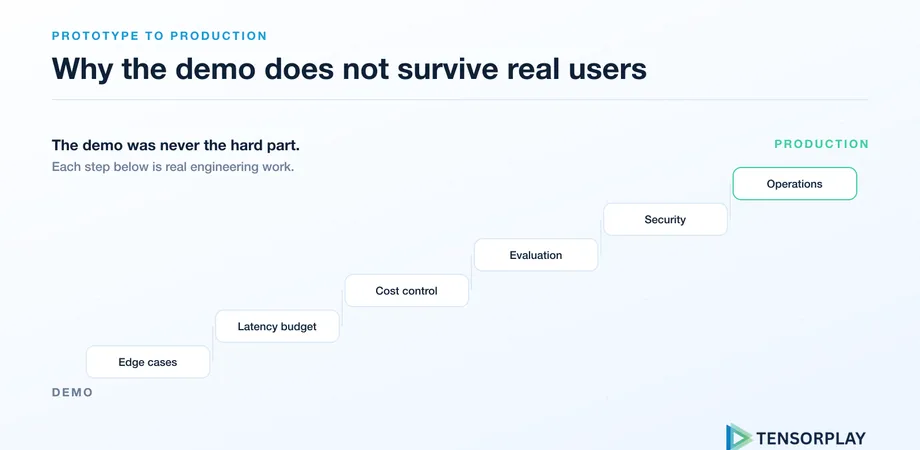
Why Your LLM Prototype Fails in Production (And How to Fix It)
- Tensorplay Engineering
- 10 Jan, 2026
- 02 Mins read
- Production-ai,Engineering
Every week, a startup team demos their new LLM-powered product and it looks brilliant. The model answers questions accurately, the UI feels snappy, and the investors are impressed. Then they launch — and everything breaks.
This is the story we hear constantly at Tensorplay. And after helping dozens of companies navigate this transition, we’ve identified the five most common failure modes.
1. You’re Calling the API Synchronously
The fastest way to make your LLM application feel broken is to have your user staring at a spinner while you wait for a full response. The fix is almost always streaming — using Server-Sent Events (SSE) or WebSockets to push tokens to the client as they’re generated.
But streaming introduces new complexity: you need to handle partial JSON, streaming errors, and client disconnection gracefully. Most prototypes handle none of these.
2. You Have No Retry or Fallback Logic
Rate limits, timeouts, and model API outages are part of life in production AI. If your prototype has a direct openai.chat() call with no retry logic, you’re one API hiccup away from a completely broken user experience.
Production systems need exponential backoff, circuit breakers, and ideally fallback routes — whether to a different model, a cached response, or a graceful degradation message.
3. Your Context Window Isn’t Managed
In demos, you typically have control over the exact conversation you’re testing. In production, users have long, unpredictable conversations that quickly overflow the context window — causing silent truncation and surprisingly bad model behavior.
You need a proper context management strategy: summarization of older messages, sliding window approaches, or retrieval-augmented memory. Without this, your model will appear to “forget” things and confuse users.
4. You Have No Observability
In a demo, you know exactly what prompts you’re sending. In production, you’re flying blind. Without logging, latency tracking, and output monitoring, you can’t answer basic questions: Which queries are slow? Which prompts are causing hallucinations? Where is your p95 latency?
Invest in structured logging from day one. Tag every LLM call with a request ID, the prompt template used, the model version, and the latency. You’ll thank yourself later.
5. Your Prompts Aren’t Versioned
Prompts are code. They need to be version-controlled, tested before deployment, and rolled back if they cause regressions. Most prototypes have the system prompt hardcoded in the source file with no history of changes.
Treat your prompt templates like you treat your database migrations — intentional, versioned, and tested.
The good news: all of these are fixable. The even better news is that fixing them correctly the first time is dramatically faster than debugging production incidents after the fact. If your team is approaching a launch and you’re not sure your AI system is production-ready, get in touch with us — it’s exactly what we do.
Frequently asked questions
Answers to common questions about this topic.
Why do LLM prototypes fail in production?
How do I add retry logic to an LLM application?
What is context window management in LLMs?
What observability do I need for a production LLM?
How should I version control LLM prompts?
Related articles
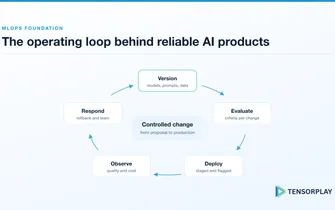
The MLOps Foundation CTOs Need for Reliable AI Products
The operating model behind reliable AI MLOps is the set of operating capabilities that lets a team c...
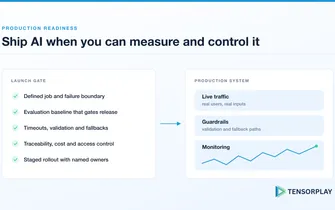
AI Production Readiness Checklist for CTOs
What production-ready actually means An AI feature is ready for production when your team can measur...
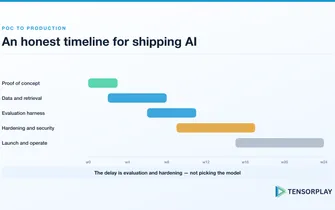
From PoC to Production: An Honest Engineering Timeline
One of the most frequent conversations we have with new clients starts the same way: "We have a work...
How Tensorplay can help
Production AI Architecture
Turn prototypes into reliable, observable, and scalable AI systems.
Discuss your project