Prompt Engineering at Scale: Moving Beyond Hacks
- Tensorplay Engineering
- 10 Mar, 2026
- 02 Mins read
- Llm,Engineering
Prompt engineering has a reputation problem. For many developers, it conjures images of trial-and-error, magical incantations, and vague advice like “be more specific.” At small scale — one or two prompts — that approach is fine. At production scale — dozens of prompt templates, multiple models, and continuous iteration — it’s a disaster.
Here’s how we think about prompt engineering as a proper engineering discipline.
Treat Prompts as Code
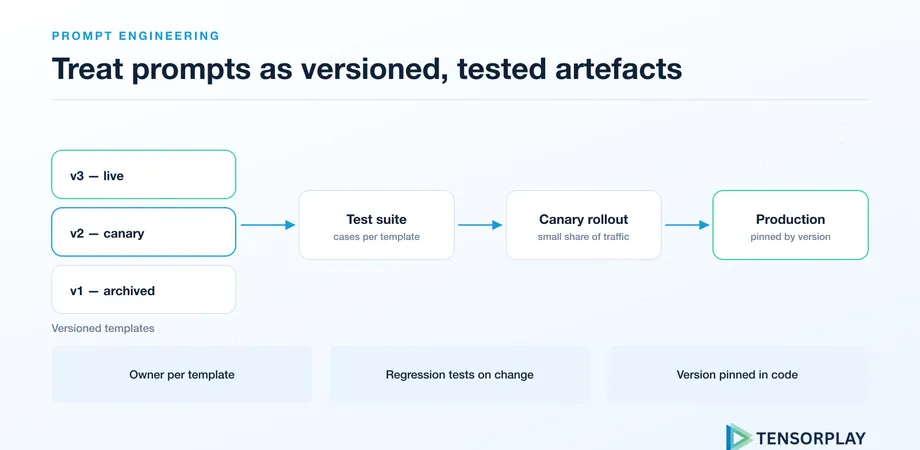
This is the foundational rule. Prompts belong in version control (not hardcoded in application files), they have tests, they go through code review, and changes to them have a deployment process.
We typically store prompts as YAML files that include:
- The prompt template with clearly named variables
- The model and parameters it’s designed for
- The version number and changelog
- The evaluation criteria for this prompt
- Example inputs and expected outputs
Define a Prompt Testing Pipeline
Every prompt change should run against your evaluation suite before it can be merged. This means having:
- A set of regression test cases representing the distribution of real inputs
- Automated metrics appropriate for your task (format checks, semantic similarity, LLM judge)
- A clear threshold: “this change must not reduce eval score by more than X%”
Without this, you’re shipping prompt changes blind and wondering why your users are suddenly getting worse responses two weeks after a “small” update.
A/B Testing Prompts in Production
For prompt changes that pass offline evaluation but you’re not fully confident about, run a production A/B test. Route 10% of traffic to the new prompt and compare real user quality signals — engagement, thumbs up/down feedback, follow-up questions (a sign of incomplete answers), and support escalations.
Build this infrastructure once and it pays off every time you iterate on any prompt.
Use Structured Outputs Everywhere
When your prompt needs to return structured information, always specify a JSON schema and use your LLM provider’s structured output features (OpenAI’s response_format, Instructor, Outlines, etc.). Never parse free-form text when you don’t have to.
Structured outputs eliminate a whole class of failures and make your system dramatically more robust — you always know exactly what shape the data will be.
Separate System, User, and Context Prompts
Many applications mix all prompt content into one blob. Instead, maintain clear separation:
- System prompt: Persona, constraints, output format — stable, rarely changes
- Context prompt: Retrieved documents, user history — dynamic per-request
- User message: The actual user input — untrusted, always sanitize
This separation makes each piece easier to iterate on independently and easier to debug when something goes wrong.
Prompt engineering done right is software engineering. If your team is struggling to maintain quality across a growing library of prompts, we’d love to help you build the right systems.
Related articles
How to Make a RAG System Reliable in Production
The reliability boundary in RAG A reliable RAG system retrieves authorized, current, relevant eviden...
How CTOs Should Build an LLM Evaluation Framework
The evaluation decision CTOs need to make An LLM evaluation framework converts "does this feel bette...
AI Production Readiness Checklist for CTOs
What production-ready actually means An AI feature is ready for production when your team can measur...
How Tensorplay can help
Production AI Architecture
Turn prototypes into reliable, observable, and scalable AI systems.
Discuss your projectModel Optimization & Evaluation
Improve model quality, control costs, and establish repeatable evaluation systems.
Discuss your project